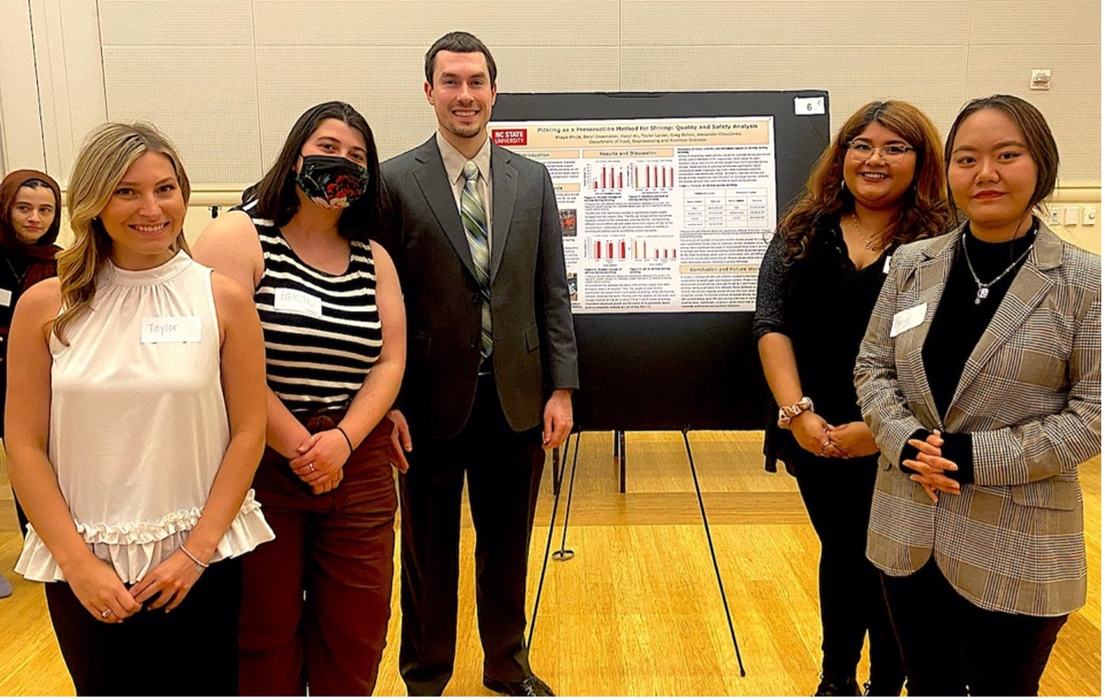
Alex Chouljenko (center) is pictured with the four participating students at a poster presentation detailing their research on pickling shrimp. From left to right: Taylor Lanier, Beryl Shoemaker, Anaya Ahuja, and Haoyi An.
This article was authored and published by Sherry Faithful, Communication Specialist, at the NC State Center for Marine Sciences and Technology.
The NC State Seafood Lab, at the Center for Marine Sciences and Technology (CMAST) in Morehead City, has been working with four undergraduate students on a research project to develop a pickled shrimp product to evaluate the quality and safety of a process to preserve raw shrimp. Alex Chouljenko, director of the CMAST seafood lab, and Greg Bolton, research assistant, designed and led the study. Participating students recently presented a poster at the NC State Undergraduate Research and Creativity Symposium to explain the process of the study and the results, as indicated below.
Shrimp is one of the most widely consumed seafoods in the United States, and in North Carolina, small-scale fishermen and seafood processors contribute to the commercial shrimp supply. Unfortunately, though, shrimp is also highly perishable. Chouljenko says pickling shrimp could solve this problem. “Pickled shrimp is not currently available in the marketplace, and research on this topic is limited. A pickled shrimp product developed for the commercial market would support small-scale fisheries and processors to extend shelf life and allow for off-season availability of shrimp products.”
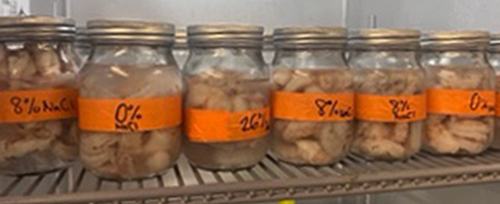
Researching methods of brining raw shrimp with various salt solutions.
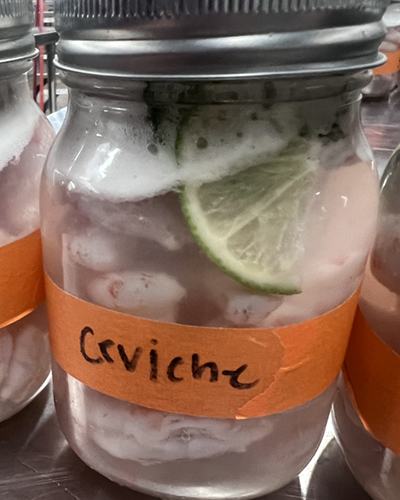
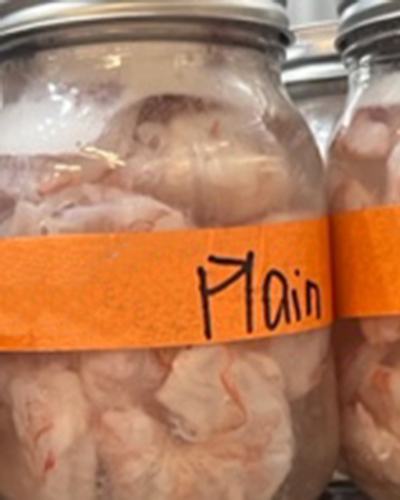
The study involved two phases using raw white shrimp, supplied by a local seafood processor, Pamlico Packing Co., Inc., in Grantsboro, NC. In phase one, shrimp were brined using different salt concentrations. In phase two, the shrimp was brined and then pickled, with ceviche and citrus flavors added.
According to Chouljenko, the ceviche-pickled shrimp had the most desirable properties overall. “Development of the pickled shrimp product may expand the seafood market, allow consumers to have more access to healthy and safe food options, and increase revenue for local fisheries…to provide a shelf-stable product that is available year-round.”
This study is just one example of ongoing research and collaboration conducted through the seafood lab. According to Dr. David Eggleston, NC State professor and director of CMAST, “Our seafood program [continually…works] with the seafood industry to provide training on safe handling of seafood, developing new seafood products, and identifying ways to improve shelf-life of seafood products.”